

bolt Kurz gesagt In Short
Erst die Erwartung prüfen: Eine Fußbodenheizung reagiert träge und braucht Stunden, nicht Minuten. Wird sie gar nicht warm, liegt es meist an Luft im System (am Verteiler entlüften), einem geschlossenen Stellantrieb, zu wenig Druck oder Verschlammung. Entlüften, Druck und Stellantriebe prüfen Sie selbst – für Spülung und hydraulischen Abgleich kommt der Profi. First check your expectations: underfloor heating reacts slowly and needs hours, not minutes. If it doesn't get warm at all, it's usually air in the system (bleed at the manifold), a closed actuator, too little pressure or sludge. Bleeding, pressure and actuators you can check yourself – for flushing and hydraulic balancing, call the pro.
Erst mal wichtig: Eine Fußbodenheizung ist träge First Things First: Underfloor Heating Is Slow
Anders als ein Heizkörper arbeitet die Fußbodenheizung mit einer großen Fläche und niedriger Vorlauftemperatur. Der Estrich speichert die Wärme und gibt sie langsam ab – das ist angenehm und effizient, bedeutet aber: Sie wird nie in Minuten „heiß", sondern über Stunden gleichmäßig warm. Bevor Sie einen Defekt vermuten, geben Sie ihr also Zeit und lassen Sie sie durchlaufen, statt ständig auf- und abzudrehen. Wird der Boden auch nach Stunden nirgends warm, lohnt die Fehlersuche. Unlike a radiator, underfloor heating works with a large surface and a low flow temperature. The screed stores the heat and releases it slowly – pleasant and efficient, but it means: it never gets "hot" in minutes, it warms up evenly over hours. So before you suspect a fault, give it time and let it run continuously instead of constantly turning it up and down. If the floor stays cold everywhere even after hours, it's worth troubleshooting.
Die häufigsten Ursachen The Most Common Causes
- Luft im System: Der Klassiker. Luft sammelt sich in den Kreisen und blockiert den Durchfluss – dann hilft Entlüften, bei der Fußbodenheizung am Heizkreisverteiler. Air in the system: the classic. Air collects in the loops and blocks the flow – then bleeding helps, in underfloor heating at the manifold.
- Stellantrieb oder Raumthermostat: Fordert der Thermostat keine Wärme an oder ist der Stellantrieb am Verteiler defekt, bleibt der Kreis zu und der Raum kalt. Actuator or room thermostat: if the thermostat doesn't call for heat or the actuator at the manifold is faulty, the loop stays closed and the room cold.
- Zu wenig Wasserdruck: Fällt der Druck unter etwa 1 bar, zirkuliert das Wasser nicht mehr richtig. Too little water pressure: if the pressure drops below about 1 bar, the water no longer circulates properly.
- Verschlammung: Nach Jahren setzen sich Schlamm und Ablagerungen in den langen Rohren ab und bremsen den Durchfluss – typisch, wenn einzelne Kreise immer kälter werden. Sludge: after years, sludge and deposits build up in the long pipes and slow the flow – typical when individual loops get colder and colder.
- Pumpe oder Einstellung: Eine defekte Umwälzpumpe, eine zu niedrige Vorlauftemperatur oder ein fehlender hydraulischer Abgleich sorgen dafür, dass die Wärme nicht gleichmäßig ankommt. Pump or settings: a faulty circulation pump, a flow temperature set too low or missing hydraulic balancing mean the heat doesn't arrive evenly.
Selbst prüfen & entlüften – am Heizkreisverteiler Check & Bleed Yourself – at the Manifold
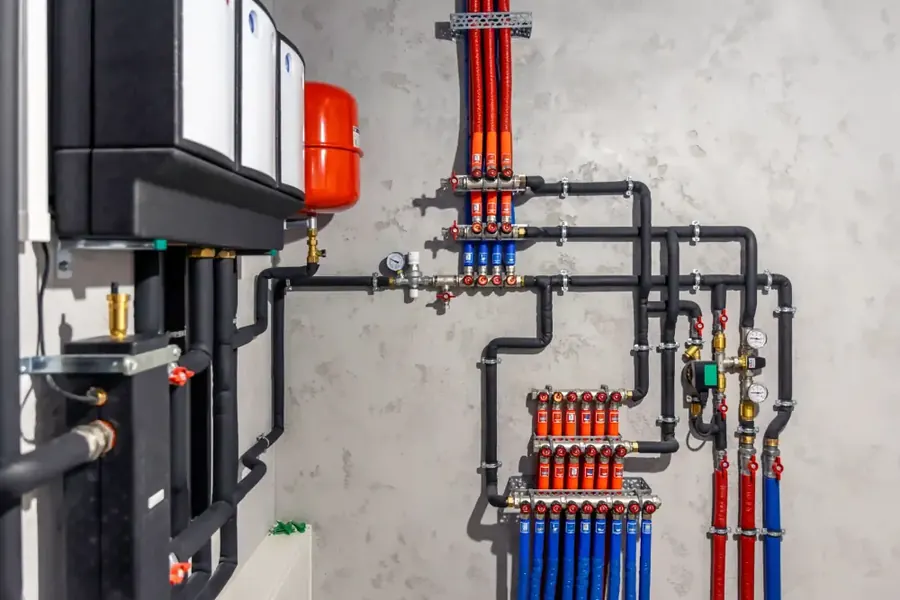
Der Heizkreisverteiler (meist im Technikraum, Bad oder Flur in einem Schrank) ist die Schaltzentrale. Von dort aus prüfen Sie die Kreise der Reihe nach. The manifold (usually in a cabinet in the utility room, bathroom or hallway) is the control hub. From there you check the loops one by one.
Kalten Kreis finden Find the Cold Loop
Rücklaufrohre am Verteiler abtasten: ein kalter Kreis bei warmem Vorlauf zeigt, wo es hakt. Feel the return pipes at the manifold: a cold loop with a warm flow shows where it's stuck.
Thermostat & Stellantrieb Thermostat & Actuator
Fordert der Raumthermostat Wärme an? Öffnet der Stellantrieb? Leere Batterien tauschen. Is the room thermostat calling for heat? Does the actuator open? Replace empty batteries.
Wasserdruck prüfen Check the Pressure
Manometer unter ~1 bar? Vorsichtig auf 1–2 bar nachfüllen. Gauge below ~1 bar? Carefully top up to 1–2 bar.
Kreise entlüften Bleed the Loops
Pumpe kurz aus, jeden Kreis am Verteiler entlüften, bis blasenfreies Wasser kommt. Danach Druck prüfen. Pump off briefly, bleed each loop at the manifold until bubble-free water comes. Then check the pressure.
Durchfluss prüfen Check the Flow
An den Durchflussmessern sehen, ob jeder Kreis Wasser bekommt. Zugedrehte Kreise öffnen. Check the flow meters to see each loop gets water. Open any closed loops.
Bleibt kalt: Profi Still Cold: Pro
Hilft alles nichts, ist oft Spülung, Stellantrieb-Tausch oder ein hydraulischer Abgleich nötig. If nothing helps, a flush, actuator replacement or hydraulic balancing is often needed.
lightbulb Nicht wild an den Kreisen drehen Don't Randomly Adjust the Loops
Die Durchflussmesser am Verteiler sind beim Einbau aufeinander abgestimmt (hydraulischer Abgleich). Wer sie wahllos verstellt, bringt das ganze System aus dem Gleichgewicht – dann wird ein Raum zu heiß und der nächste kalt. Öffnen Sie nur versehentlich zugedrehte Kreise; die Feineinstellung überlässt man besser dem Profi. Startet die Therme gar nicht erst, hilft unser Beitrag Gastherme fällt aus. The flow meters at the manifold are balanced to each other during installation (hydraulic balancing). Adjusting them at random throws the whole system off – one room gets too hot, the next stays cold. Only open loops that were accidentally closed; leave the fine-tuning to the pro. If the boiler won't start at all, see our article gas boiler fails.
Wann der Profi ran muss When the Pro Needs to Step In
- Einzelne Kreise bleiben kalt: Trotz Entlüften – ein typisches Zeichen für Verschlammung oder einen defekten Stellantrieb. Individual loops stay cold: despite bleeding – a typical sign of sludge or a faulty actuator.
- Verschlammte Anlage: Hier hilft nur eine professionelle Spülung bzw. Entschlammung, damit die Kreise wieder frei werden. Sludged-up system: only a professional flush/desludge helps here so the loops are clear again.
- Räume ungleichmäßig warm: Dann fehlt meist der hydraulische Abgleich – der Profi reguliert die Kreise sauber ein. Rooms heat unevenly: then hydraulic balancing is usually missing – the pro balances the loops properly.
- Pumpe oder Therme defekt: Läuft die Umwälzpumpe nicht oder zeigt die Therme eine Störung, muss die Diagnose vom Fachbetrieb kommen. Pump or boiler faulty: if the circulation pump doesn't run or the boiler shows a fault, the diagnosis must come from the professional.
"Eine Fußbodenheizung verzeiht viel – aber keine Ungeduld. Gleichmäßig laufen lassen, einmal richtig entlüften und abgleichen, dann läuft sie oft jahrelang unauffällig." "Underfloor heating forgives a lot – but not impatience. Let it run evenly, bleed and balance it properly once, and it often runs quietly for years."
Was macht der Profi bei π-THERM? What Does the π-THERM Pro Do?
Diagnose Diagnosis
Wir prüfen Kreise, Stellantriebe, Druck und Pumpe und finden den kalten Kreis gezielt. We check loops, actuators, pressure and pump and pinpoint the cold loop.
Spülung & Entschlammung Flushing & Desludging
Verschlammte Kreise spülen wir frei – so kommt die Wärme wieder im ganzen Boden an. We flush sludged loops clear – so the heat reaches the whole floor again.
Hydraulischer Abgleich Hydraulic Balancing
Wir regulieren die Kreise so ein, dass jeder Raum gleichmäßig warm wird – und die Heizung effizient läuft. We balance the loops so every room heats evenly – and the system runs efficiently.
Stellantrieb & Pumpe Actuator & Pump
Defekte Stellantriebe oder eine kaputte Umwälzpumpe tauschen wir fachgerecht. We professionally replace faulty actuators or a broken circulation pump.
star π-THERM Heizungsservice – Ihre Vorteile π-THERM Heating Service – Your Advantages
Erfahrung mit Flächenheizung: Wir kennen Verteiler, Stellantriebe und die Tücken langer Heizkreise. Experience with surface heating: we know manifolds, actuators and the quirks of long heating loops.
Gleichmäßig warm: Mit Spülung und Abgleich bringen wir die Wärme wieder in jeden Raum. Evenly warm: with flushing and balancing we bring the heat back to every room.
Meisterbetrieb in Wien: Saubere, fachgerechte Arbeit an Heizung, Verteiler und Therme. Master company in Vienna: clean, professional work on heating, manifold and boiler.
Häufige Fragen zur Fußbodenheizung Frequently Asked Questions About Underfloor Heating
Warum wird meine Fußbodenheizung nicht warm? Why won't my underfloor heating get warm?
Häufig ist Luft im System (am Heizkreisverteiler entlüften), ein geschlossener Stellantrieb bzw. ein Raumthermostat ohne Wärmeanforderung, zu wenig Wasserdruck oder eine verschlammte Anlage die Ursache. Manchmal ist die Fußbodenheizung auch nur träge und braucht einfach länger als ein Heizkörper. Often it's air in the system (bleed at the manifold), a closed actuator or a room thermostat not calling for heat, too little water pressure or a sludged-up system. Sometimes the underfloor heating is simply slow and just needs longer than a radiator.
Wie lange braucht eine Fußbodenheizung, bis sie warm wird? How long does underfloor heating take to warm up?
Deutlich länger als Heizkörper: je nach Estrich und Bodenbelag Stunden, nicht Minuten. Deshalb lässt man eine Fußbodenheizung am besten gleichmäßig durchlaufen, statt sie ständig auf- und abzudrehen. Much longer than radiators: depending on the screed and floor covering, hours, not minutes. That's why it's best to let underfloor heating run evenly instead of constantly turning it up and down.
Wie entlüftet man eine Fußbodenheizung? How do you bleed underfloor heating?
Über die Entlüftungsventile am Heizkreisverteiler. Die Umwälzpumpe kurz ausschalten, dann jeden Kreis einzeln entlüften, bis blasenfreies Wasser kommt. Anschließend den Wasserdruck prüfen und bei Bedarf nachfüllen. Bei Unsicherheit hilft der Fachbetrieb. Via the bleed valves at the manifold. Switch off the circulation pump briefly, then bleed each loop individually until bubble-free water comes. Then check the water pressure and top up if needed. If unsure, the professional can help.
Nur ein Raum wird nicht warm – woran liegt das? Only one room won't get warm – why?
Dann liegt es meist am einzelnen Heizkreis: Luft, ein defekter Stellantrieb, ein zugedrehter Durchflussmesser oder ein Raumthermostat, der keine Wärme anfordert. Bleiben mehrere Räume kalt, steckt die Ursache eher zentral – Pumpe, zu wenig Druck oder Verschlammung. Then it's usually the individual loop: air, a faulty actuator, a closed flow meter or a room thermostat not calling for heat. If several rooms stay cold, the cause is more central – pump, too little pressure or sludge.
Was ist eine verschlammte Fußbodenheizung? What is a sludged-up underfloor heating?
Über die Jahre lagern sich Schlamm und Ablagerungen in den Rohren ab und bremsen den Durchfluss, sodass die Wärme nicht mehr ankommt. Eine professionelle Spülung (Entschlammung) macht die Kreise wieder frei und die Fußbodenheizung gleichmäßig warm. Over the years, sludge and deposits build up in the pipes and slow the flow, so the heat no longer arrives. A professional flush (desludging) clears the loops again and makes the underfloor heating evenly warm.
Wann sollte ich den Profi rufen? When should I call the pro?
Wenn Entlüften und Druckprüfung nicht helfen, einzelne Kreise dauerhaft kalt bleiben, die Anlage verschlammt ist oder ein hydraulischer Abgleich fehlt. Dann gehört die Diagnose in Fachhände. When bleeding and a pressure check don't help, individual loops stay cold, the system is sludged up or hydraulic balancing is missing. Then the diagnosis belongs in expert hands.